How to Apply for Physical Therapy Jobs in Canada
A Complete Guide for Internationally Trained Physiotherapists
Canada continues to experience a strong demand for Physical Therapists, creating excellent long-term career opportunities for internationally educated PTs. However, the process of becoming job-ready can be more extensive than many expect, especially when it comes to credentialing and licensure exams.
Quick Summary
This guide walks you through the full process of becoming a licensed physiotherapist (PT) in Canada if you were educated and trained abroad. We cover CAPR credential review, language requirements, timeline, licensing steps, visa/immigration considerations, expected salaries, and what you should know before you start applying for jobs.
Table of Contents
CAPR Credentialing Overview Before You Can Apply for Physical Therapy jobs in Canada for Foreigners
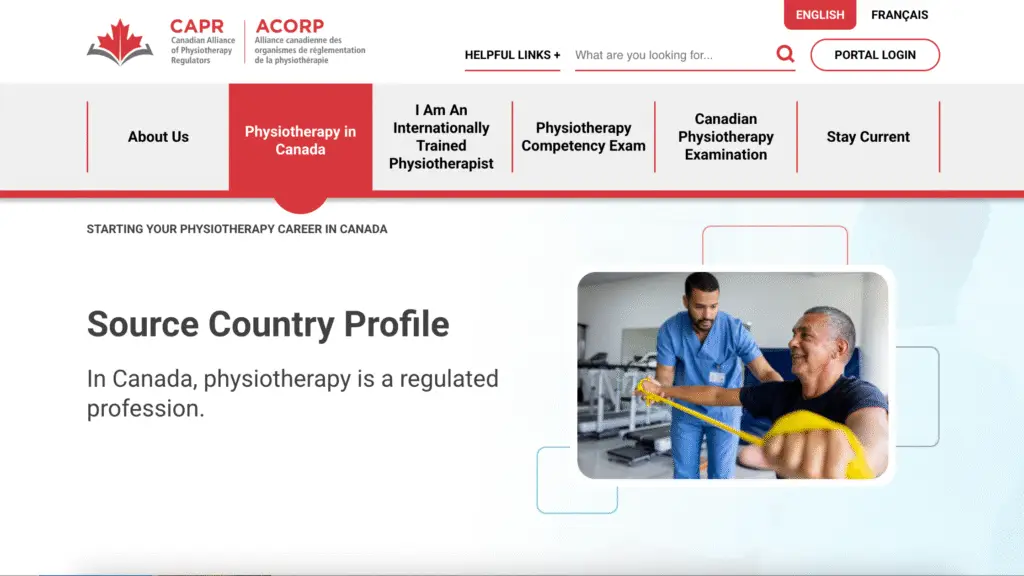
In Canada, physiotherapy is a regulated profession. The relevant regulatory body must issue your license before you can practice.
CAPR starts the licensing journey for internationally educated physiotherapists (IEPTs) by reviewing their credentials. This credentialing process checks if your education and training matches the standards of a Canadian-educated PT.
CAPR divides its assessment into two stages.
Stage 1: Credential Review — verify your education, clinical training, documentation, etc.
Stage 2: Competency Exam — once credentialling is approved, you must pass the licensing exam to demonstrate you meet minimum standards of competence.
Credentialling Requirements
To satisfy Stage 1, your background must meet these criteria:
Valid, authentic documentation of identity, education credentials, and training. Fraudulent or irregular documents may cause outright rejection.
You must hold a recognized university-level physiotherapy degree or an equivalent credential. CAPR may accept diplomas from non-university institutions if they assess them as equivalent to at least a Canadian Bachelor’s degree.
At least 1,025 hours of supervised clinical practice (also called clinical placements, internship, practicum)—with minimum sub-requirements: 100 hours in musculoskeletal conditions, 100 hours in neurological conditions, and 40 hours in cardiorespiratory conditions.
Proof of fluency in either English or French (unless your physiotherapy education — both classroom & clinical — was entirely in English or French in certain exempt jurisdictions).
Completion of a pre-approved course about physiotherapy practice in the Canadian health-care context. Examples: University of Toronto’s “Physiotherapy Practice within the Canadian Healthcare Context” or University of Alberta’s “Physiotherapy Practice in the Canadian Healthcare System”.
Once CAPR approves your credentials, you become eligible to take the licensing exam.
Prove Your English Fluency Before Credentialing Can Begin
If you graduated from a non-English-speaking country, you must prove your English fluency before CAPR starts your credentialing assessment. This is essential for applying for physical therapy jobs in Canada for foreigners.
One of the standard requirements before CAPR will start assessing your application is demonstration of language proficiency (English or French).
CAPR accepts tests such as IELTS Academic, TOEFL, or other approved exams if you completed your PT education outside exempt countries.
If you finished all courses and clinical training in English or French in an exempt country, CAPR may waive the language test.
Important: Without valid language test results (if required), CAPR will not begin the credentialling process.
Timeline: How Long Does the Process Take Before You Can Work in Canada as a PT?
The overall timeline varies based on how fast you gather documents, CAPR’s workload, and how soon you pass your exams.
- 3-4 Months: Take English Review and Pass English Exam
6-10 Months: CAPR Credentialing Assessment Timeline (once you submit a complete file).
- 12-24 Months: Review and preparation for the Physiotherapy Competency Exam. Of course this will vary on your ability and foundational knowledge. Timeline is estimated based on the current passing rate of Filipino PTs in the PCE.
After approval, scheduling and passing the licensing exam (the Physiotherapy Competency Examination (PCE) — or under upcoming changes, the new single licensure exam Canadian Physiotherapy Examination (CPTE)) will add more time.
Many internationally educated PTs experience delays because of credentialing backlogs and the time needed to prepare for the exam.
24 months to 40 months before you can work as PT in Canada*
*In total, from application to fully licensed PT in Canada (assuming everything goes smoothly) the process may take several months up to a year or more.
Challenges in Exam Review & Preparation — What You Should Know
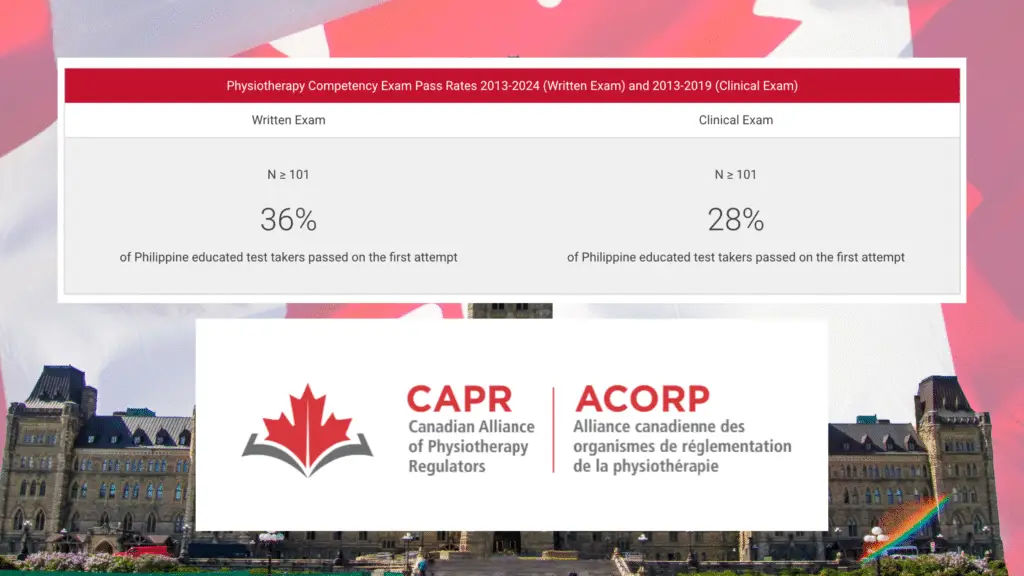
7 out of 10 Filipino PTs Failed their First Attempt on the PCE – Written Exam
The PCE exam (and previously, the two-part process including written and clinical components) has been notoriously difficult for many internationally educated PTs.
Historically pass rates have been significantly lower compared to those educated in Canada.
Recently, the regulatory body announced upcoming changes: starting January 2026, CAPR will implement the CPTE — a single licensure exam, combining written and scenario-based/oral components, administered virtually.
Because of exam complexity and historically lower pass rates for IEPTs, many internationally trained physiotherapists opt to enroll in bridging or preparatory programs. The Ontario Internationally Educated Physical Therapist Bridging Program (OIEPB) at the University of Toronto offers focused preparation for the exam and Canadian PT practice.
PTs from countries with few review centers, such as the Philippines, often rely on online resources, practice exams, or study groups to prepare effectively.
Recommendation:
Start preparing early. Give yourself several months for review and use reliable preparatory materials (e.g., from bridging programs, online courses, practice exams).
Provincial Licensing After Passing the Exam
After passing the CAPR exam (or the future CPTE), you must apply to the provincial regulator to receive your PT license. CAPR only conducts credentialing and the competency exam; actual license issuance is done by provincial regulators.
For example, in some provinces, after passing the written exam, international PTs may need to pass a clinical exam (or similar assessment) or fulfill other province-specific requirements before full independent practice is allowed.
With the CPTE launching in 2026, provinces may align their licensing processes, but you should still check the specific requirements in the province where you plan to work.
Visa & Immigration Options for Foreign PTs
(Please note: this is general guidance. Immigration and visa regulations change — always check official Canadian government / immigration websites.)
As an internationally trained physiotherapist, you must secure legal status to live and work in Canada. This could mean permanent residency, work permit, or other visa type depending on your intended approach.
Some employers may sponsor foreign-trained PTs, especially if there’s demand in certain provinces or communities (e.g., rural areas, long-term care, rehabilitation centers).
CAPR manages credentialing, but immigration is a separate process. Starting credentialing early strengthens your profile before applying for visas or jobs.
Visa Options for PTs applying to Canada
Visa options are able for those looking for physical therapy jobs in Canada for foreigners. Consider applying under Canadian immigration pathways for skilled workers if eligible (for example, through federal programs, provincial nominee programs, or employer-sponsored categories).
Do You Need an Employer First Before You Apply for a Canadian Visa?
Not necessarily. Many foreign-trained PTs begin with credential evaluation and exam preparation before securing an employer. Having a license (or at least being eligible to be licensed) can strengthen your job candidacy.
However, having a Canadian employer offer can significantly improve your chances for certain visa/immigration streams (especially employer-sponsored or provincial-nominee paths).
It’s often strategic to coordinate licensing and immigration plans: start credentialling early, prepare for the exam, while simultaneously exploring visa options or contacting potential employers in Canada.
PT Salary in Canada — What to Expect
Physiotherapy salaries in Canada vary by province, work setting, years of experience, and clinical specialty.
As a rough estimate: entry-level physiotherapists (recently licensed) often find jobs in outpatient clinics, rehabilitation centers, or long-term care facilities. Salaries are generally competitive compared with many countries in Asia — one of the primary attractions for foreign PTs moving to Canada.
Factors to Consider about Physical Therapists Salary in Canada
Additional benefits may include employer-sponsored health coverage, retirement savings plans, paid allowances, and opportunities for specialization or further education.
Over time, with Canadian work experience and specialization, PTs can expect improved earning potential, job stability, and career growth.
(Note: Because salary ranges differ widely by region and employer, it’s best to research job postings in the province of interest for more accurate figures.)
Additional Tips & Considerations When Applying for Physical Therapy jobs in Canada for Foreigners
Start early and gather all required documents.
Since CAPR requires official, valid documentation (academic transcripts, clinical placement records, identity verification), make sure you have everything in order. Delays often come from missing/irregular paperwork.
Account for fees and costs.
Credentialling, exam registration, translation (if needed), language tests, and course(s) about Canadian health-care context may involve nontrivial costs. While there are some bursary programs in certain provinces for internationally educated health professionals, you should plan finances accordingly.
Be prepared for exam challenges.
Many IEPTs report that written and clinical/competency exams are more difficult than expected — especially if they come from countries whose physiotherapy curricula differ. Investing time in solid preparation (mock exams, bridging courses, self-study) is often key.
Stay informed about regulatory changes.
As of 2025/2026, there are major changes underway in the licensure exam system: the shift to the CPTE (single exam) may affect how and when you apply. Make sure you refer to the official CAPR announcements.
Network with other internationally educated PTs.
Connecting with other foreign-trained physiotherapists who have moved to Canada can provide valuable insight, support, and practical tips (on exam prep, job search, immigration, adapting to Canadian health-care system).
Frequently Asked Questions (FAQs) of foreign PTs applying for physical therapy jobs in Canada
Yes. Canada allows internationally educated physiotherapists to work in the country, but only after completing the CAPR credentialling process, passing the required licensing exam, and obtaining a provincial physiotherapy license.
Most foreign-trained applicants must take an approved English or French language proficiency test unless their physiotherapy education was completed entirely in English/French in a CAPR-recognized exempt country. Note that this is needed before CAPR can begin their assessment of your credentials.
The timeline varies, but most applicants take several months to a year to complete. Based on Filipino PTs who have migrated to Canada, the process can take up 24 months and even up to 40 months or more, depending on how early you pass the Physiotherapy Competency Exam.
Many internationally educated PTs find the exam challenging due to differences in curriculum, testing format, and clinical expectations. Pass rates for foreign-trained candidates have historically been lower, which is why bridging programs and dedicated review courses are highly recommended.
Not always. You can begin CAPR credential assessment and exam preparation without an employer. However, having a job offer can strengthen your visa or immigration application, especially for employer-sponsored or provincial nominee programs.
No. CAPR does not issue licenses. After passing, you must apply to the provincial regulatory college (e.g., Ontario, British Columbia, Alberta) to obtain your official physiotherapy license.
Final Conclusion
Becoming a licensed physiotherapist in Canada as a foreign-trained practitioner may feel like a long and complex journey—but it is absolutely achievable with the right preparation and understanding of the process.
Each step—credential assessment, language testing, exam preparation, and provincial licensing—moves you closer to a stable and well-paid PT career in Canada.
Canada’s demand for skilled physiotherapists continues to grow, especially in rehabilitation centers, long-term care facilities, outpatient clinics, and rural communities.
Apply Early for Physical Therapy jobs in Canada for Foreigners
For many internationally educated PTs—including those from the Philippines, India, Middle East, and beyond—the transition can unlock better career opportunities, competitive salaries, and long-term stability for their families.
If you start early, organize your documents well, and prepare for the exam, you can transition smoothly into the Canadian physiotherapy workforce.
With dedication and the right guidance, your goal of practicing as a licensed physiotherapist in Canada can become a reality.