How Hard Is the Canadian Physiotherapy Competency Exam?
What Internationally-Educated PTs (IEPTs) Should Know
Quick Summary and Answer:
The Canadian Physiotherapy competency exam is challenging for many internationally-educated physiotherapists (IEPTs) — historically IEPTs have lower first-time pass rates than Canadian-educated candidates.
Success improves dramatically with targeted preparation (bridging programs, clinical orientation to Canadian practice).
Expect to invest time, money, and focused study; but many IEPTs who prepare well do pass and go on to stable careers in Canada.
Table of Contents
What is the Canadian Physiotherapy Competency exam and who administers it?
The Canadian Alliance of Physiotherapy Regulators (CAPR; sometimes referred to as the Alliance) evaluates credentials of internationally-trained applicants and administers the Physiotherapy Competency Examination (PCE) — the competency assessment required to be eligible for independent licensure in most provinces. CAPR has been evolving the exam model (timing and format), and regulators continue to align national standards.
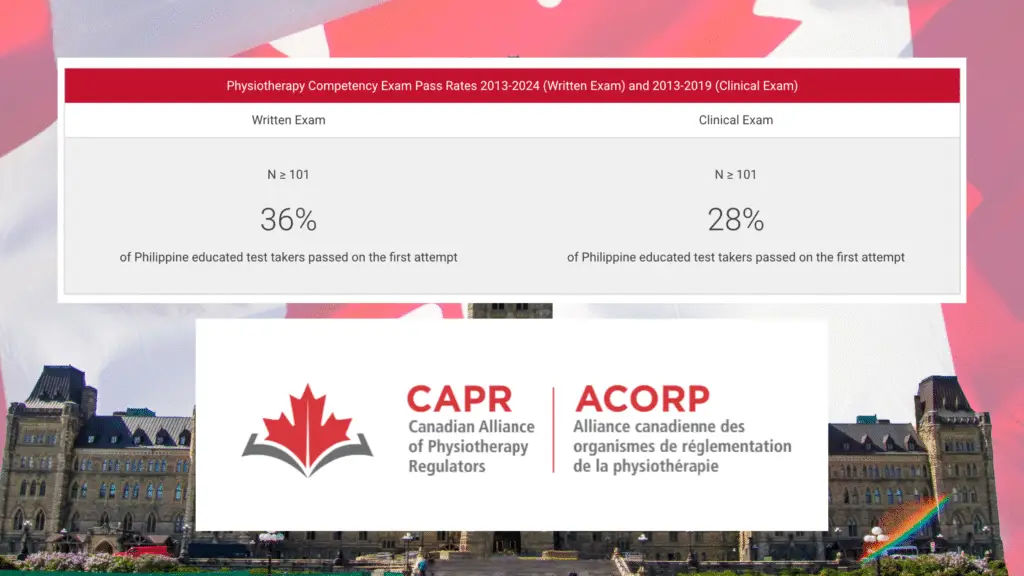
How hard is it — measured by pass rates?
Short answer: Relative to Canadian-trained candidates, IEPT first-time pass rates are lower and failure on the first attempt is common enough that many regulatory pages warn against using an attempt as “practice.” CAPR permits a maximum number of attempts, and historically regulators and professional groups underscore the need for serious preparation.
A few evidence points worth noting:
Academic and health-systems studies report marked differences between Canadian-educated and internationally-educated candidates’ pass rates on clinical and written components — IEPTs make up a significant share of exam takers and historically have lower pass rates, particularly on the clinical component.
Bridging and orientation programs in Canada (for example, university bridging programs) show substantially better outcomes for IEPTs who complete them — one study reported roughly 80% pass rates for IEPTs who attended a respected bridging program. That suggests the exam’s difficulty is strongly tied to differences in practice context and familiarity with Canadian clinical expectations, not just clinical competence per se.
Because CAPR and provincial bodies revise exam logistics and reporting over time, the absolute pass-rate number varies by year, by component (written vs clinical), and by candidate cohort. Treat the data as a clear signal: the exam is achievable but requires targeted prep — especially for IEPTs.
Why IEPTs often find the PCE harder
Three common reasons appear repeatedly in studies and regulator guidance:
Different schooling & clinical models. Curricula, patient-management styles, documentation, and expected clinical reasoning vary between countries; exam assessors mark against Canadian entry-to-practice expectations. Bridging programs help close this gap.
Exam format & high-stakes performance. The PCE includes clinical performance assessments where examiners look for specific competencies (assessment interpretation, clinical reasoning, plan development), areas in which international candidates historically score lower without localized practice exposure.
Language and communication standards. Effective clinical communication and documentation in English or French (depending on province) are essential. Regulators require proof of language ability where applicable.
How to dramatically improve your chances
If you’re an IEPT planning to write the PCE, consider a three-part strategy:
Do a bridging/orientation program (if feasible) — studies show big gains in pass rates for participants. Example outcomes in one report: ~80% pass for those who completed a bridging program.
Practice clinical reasoning and Canadian-style documentation — simulated clinical exams, OSCE practice, and mock viva/structured clinical assessments are high-value. SpringerLink
Language and soft-skills prep — targeted English/French clinical communication coaching (if needed) reduces risk on performance stations and improves patient interaction ratings.
Regulators also publish official practice materials and practice exams — use CAPR resources and provincial guidance as primary study anchors.
Pass rate reality check (what the data suggests)
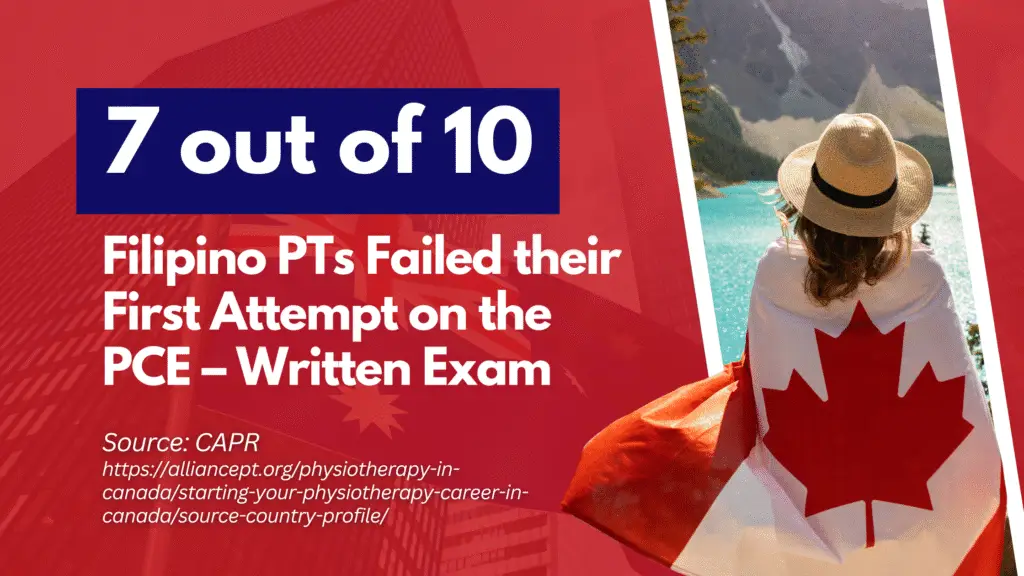
7 out of 10 Filipino PTs Failed their First Attempt on the Physiotherapy Competency Exam – Written Exam
IEPTs have lower first-time pass rates on average than Canadian-trained candidates, particularly on clinical components. (See regulator reports and academic analyses.)
Bridging programs provide consistent evidence of improved outcomes — in some program studies, pass rates for participants approached or exceeded ~80%. This is a repeated finding in Canadian academic literature.
Because CAPR and provincial regulators update formats (frequency of sittings, virtual delivery options, and integration of written/clinical components), track the latest announcements on CAPR’s site before booking an attempt.
What you can earn in Canada (brief salary overview)
If you’re needing a bit of an inspiration to beat being down to know about the pass rate, then here’s an overview of how much you can earn as a Physical therapist in Canada… if you pass the PCE!
A big reason many PTs immigrate is competitive pay and a stable health-care system. According to Job Bank / Statistics Canada, physiotherapists across Canada earned a median hourly wage around CAD $46.15/hr (with a low of about $30/hr and highs above $56/hr depending on region and setting).
If you work full-time as an entry Physical Therapist in Canada, you can earn $45,000 to $65,000 CAD per year before taxes and benefits — but entry roles, part-time work, and certain sectors (e.g., community/recreation) will start lower, while specialized roles, private practice owners, or those in acute care/remote-rural premium zones can earn more.
Remember: salary varies by province (Alberta/BC often pay more), setting (hospital vs private clinic), and experience/specialty. Factor cost of living (especially in cities such as Vancouver or Toronto) when evaluating offers.
Pros & Cons of migrating to Canada as a PT
Pros
Competitive salaries + benefits and predictable labour standards.
Universal health-care environment and strong workplace protections.
Demand in many regions (hospitals, eldercare, community rehab), with provincial nominee pathways sometimes favouring health professionals.
Cons / Realities
Up-front costs & time: credential assessment fees, exam fees, language tests, bridging program costs, and months of preparation.
Exam difficulty for IEPTs: historically lower pass rates mean you should plan to study intensively or take a bridging route.
Provincial differences: Licensing and additional provincial requirements can add steps.
- Housing crisis and shortages for newcomers.

Alternative countries to consider (pass rate & job security perspective)
If you’re weighing options beyond Canada, think about two things: licensure success probability and job market demand.
United States (NPTE):
The NPTE is rigorous but well-documented; foreign-educated candidates historically have higher NPTE pass rates. Many IEPTs succeed by completing supplemental subjects or by taking accredited DPT programs. Median PT salary in the USA is also highest in absolute dollars compared to other countries hiring international PTs, but healthcare financing and licensing complexity differ.
Australia:
Has a formal assessment (written + clinical assessments) administered by the Australian Physiotherapy Council. Studies have reported substantial fail rates among overseas candidates in some assessment formats (with some cohorts showing ~50% failure rates in specific years/domains). Australia offers pathways but the clinical assessments are strict.
United Kingdom:
Registration with HCPC requires demonstration of education equivalence and English proficiency; the UK has actively recruited internationally and offers a large public health system (NHS) with clear registration routes, though English language thresholds are strict.
Bottom line: No major destination has an “easy” licensure path — success correlates strongly with
- how closely your training matches local expectations,
- the availability of bridging/prep programs, and
- language/communication strength. For many IEPTs, Canada offers a balanced mix of demand, salary, and program availability — but Australia/UK/US remain viable alternatives depending on personal priorities and preparedness.
FAQs about Canadian Physiotherapy Competency Exam
No — regulators warn against treating an attempt as practice because first-time fail rates are common and attempts are limited. Prepare thoroughly.
No guarantee — but research shows participants have much higher pass rates than non-participants.
For many—yes. Canada offers competitive pay, public healthcare context and stable job prospects. But expect up-front time, cost, and focused exam prep.
Yes — for most internationally-educated PTs now, you get up to 3 total attempts at the licensure exam (written or new CPTE). Use your attempts carefully and prepare thoroughly.
Yes — but the structure is changing. Under the old model, you had a separate “clinical component” (clinical exam / OSCE) after the written exam. But as of 2022, CAPR discontinued delivering the clinical component of the PCE.
Starting January 2026, CAPR introduces the CPTE — a single licensure exam that combines written and clinical (scenario-based/oral) components in one exam.
Once you pass the CPTE successfully, you generally won’t need a separate provincial-level clinical exam — the CPTE fulfills the “competency exam” requirement for registration/licensure in most provinces.
So yes — a clinical assessment remains mandatory; it is just now part of the combined national exam (CPTE) as of 2026.
Alternative countries to consider (pass rate & job security perspective)
If you’re weighing options beyond Canada, think about two things: licensure success probability and job market demand.
United States (NPTE): The NPTE is rigorous but well-documented; foreign-educated candidates historically have higher NPTE pass rates. Many IEPTs succeed by completing supplemental subjects or by taking accredited DPT programs. Median PT salary in the USA is also highest in absolute dollars compared to other countries hiring international PTs, but healthcare financing and licensing complexity differ.
Australia: Has a formal assessment (written + clinical assessments) administered by the Australian Physiotherapy Council. Studies have reported substantial fail rates among overseas candidates in some assessment formats (with some cohorts showing ~50% failure rates in specific years/domains). Australia offers pathways but the clinical assessments are strict.
United Kingdom: Registration with HCPC requires demonstration of education equivalence and English proficiency; the UK has actively recruited internationally and offers a large public health system (NHS) with clear registration routes, though English language thresholds are strict.