Physical Therapist Salary in Canada | Pros and Cons of Migrating
Costs, Timeline, Benefits and Cons of Choosing Canada for migration as a Physical Therapist
Quick snapshot — the bottom line
Median physical therapist salary in Canada sits around CAD $46.15/hour (national median), with typical ranges from about $30/hr to $56+/hr depending on province and setting.
Expect to invest in credential review, exam fees, language tests, bridging courses, and living costs while you prepare — plan for CAD $35,145.22–$46,860.30+ (realistic range) before you earn Canadian pay, depending on how many courses, test re-takes, or courier/translation, consulting fee and expenses you need.
Table of Contents
Physiotherapist salary in Canada — national & provincial picture
Government data and profession surveys place the median Canadian physiotherapist wage around CAD $41–46 per hour(depending on dataset). The national labour statistics report national low/median/high hourly wages roughly $30.00 / $46.15 / $56.21 per hour (updated late 2025), with provinces such as Alberta and British Columbia often reporting the highest medians.
What that means in yearly terms:
If you work full-time as an entry Physical Therapist in Canada, you can earn $45,000 to $65,000 CAD per year before taxes and benefits — but entry roles, part-time work, and certain sectors (e.g., community/recreation) will start lower, while specialized roles, private practice owners, or those in acute care/remote-rural premium zones can earn more.
Key takeaways:
Expect significant regional variation — a PT in Alberta or BC can often earn more than the national median.
Hourly pay matters — many clinics hire PTs on hourly or contract rates rather than salaried packages.
(Primary wage sources: Statistics Canada / Job Bank and national physiotherapy profession report.)
Physical therapist salary in Canada : Comparison vs other countries
- Compared with the United States, the U.S. median annual PT wage is higher.
- Also, compared to other countries, USA and Canada both have the longest processing timelines. With Canada taking 24 months to almost 48 months.
| Country | Salary in USD | Pros | Cons |
|---|---|---|---|
|
United States |
$80,000 to $110,000 |
Highest salary Citizenship Opportunities Strong immigration pathways High demand Professional autonomy Opportunity to specialize |
Licensing can take time NPTE costs are high Immigration paperwork can be lengthy |
|
Canada |
$32,000 to $65,121 |
Easy immigration options High quality of life Family-friendly environment Path for citizenship |
Licensing process can be lengthy Credentialing is strict. English Exam needed prior credentialing assessment Cold winters Visa slots competition No agency or direct hire companies New exam format coming in 2026 |
|
United Kingdom |
$32,624 to $52,432 |
No board exam Fast processing Strong Filipino community Clear pathway to PR |
Strong job competition Starting salary is far lower compared to USA/Canada High cost of living in major cities Heavy NHS workload No citizenship pathway Prefers highly skilled/experienced PTs |
|
Australia |
$43,155 to $59,753 |
Strong wages Great climate and lifestyle Many PR pathways High demand in private and public sectors |
Difficult licensing Costly exams Competitive job market in major cities No to very few direct employers or hospitals directly hiring for foreign-PTs for visa sponsorship |
|
New Zealand |
$31,827 to 46,295 |
Easier than Australia Work-life balance is exceptional Growing opportunities |
Lower salary than Australia/Canada Fewer urban centers Limited specialty practice options |
|
Middle East |
$1,331 to $3,842 |
Tax-free salary Fast hiring No board exam in some cases Good starting point for savings Also a good starting point if you want to gain experience for PT jobs abroad before migrating to better countries like United States. |
Limited path to citizenship Conservative culture Workload can be heavy |
What affects pay: where PTs make more (and why)
Several factors determine a physical therapist salary in Canada and potential take-home:
Province / cost of living:
Higher wages in Alberta/BC tend to reflect market demand; but housing and living costs may also be higher there.
Work setting:
Hospitals and outpatient private clinics are common; outpatient specialty clinics and homecare might pay differently. Outpatient care centers in other countries sometimes pay top industry wages, and similar dynamics apply in Canada.
Experience & credentials:
Canadian experience, specialization (e.g., orthopaedics, neuro, paediatrics), and advanced certifications increase earning power.
Type of employment:
Full-time salaried roles may offer benefits (RRSP matching, health benefits) that increase overall compensation. Contract or locum roles may pay more hourly but rarely include benefits.
Real cost of becoming licensed in Canada (what you must budget)
Be prepared to pay several non-trivial fees before your first Canadian paycheck:
A. Professional Fees when assisted by a Processing Agency:
- This can sum-up from CAD $9,000 to CAD $10,000, service usually includes assistance in credentialing process and tips on getting a job — but without a guarantee of passing the credentialing, Physiotherapy Competency Exam and even getting a job.
B. Credentialling (CAPR / Alliance fees)
The standard cost for CAPR assessment of education and qualifications: CAD $2,197 (2025 figure for the assessment). Additional small admin fees (duplicate documents, courier) may apply.
C. Exam fees (Competency Examination / CPTE transition)
Historically, CAPR’s written exam component had separate fees (e.g., Written Component $1,368), and the profession is transitioning to a single Canadian Physiotherapy Examination (CPTE). Some licensing bodies list fees around CAD $2,500 for the new CPTE, with discounted transitional rates in specific periods. Expect CAD $1,400–$2,500+ depending on whether you sit legacy components or the new CPTE.
D. Language tests & translations
If your training wasn’t in English/French (or within exempt jurisdictions), you’ll need to pass approved language tests (IELTS/TOEFL) — factor in test fees, preparation courses, and possible retakes. (Costs vary by test and country.)
E. Bridging courses / prep / re-training
Many internationally educated PTs take a bridging program or exam prep course (university-run or private). Prices vary widely (CAD hundreds to several thousands).
F. Incidentals
Official transcripts, notarized translations, courier postage, and living expenses during preparation. Some international courier fees are listed (e.g., an international courier fee line item exists on credentialling pages).
Realistic total estimate (conservative): $35,145.22–$46,860.30+
before you start working in Canada. This includes the costs mentioned above plus other things like airfare, housing, visa processing and possible retake of PCE due to low pass-rate on the first take for Filipinos.
Typical timeline explained — how long until you can practice as a PT in Canada if you are from other countries?
Timelines vary significantly, but the pan-Canadian benchmark for a credential assessment is about 26 weeks once you submit a complete file — but this can be shorter or longer depending on document completeness, backlog, and re-requests for additional documentation. After credentialing, scheduling and passing the licensing exam(s) and provincial registration adds further time.
Example pathway timeline (typical):
Gather documents & language tests — 1–3 months (varies).
Submit credentialling — official processing standard ≈ 26 weeks (some applicants faster; some slower).
Exam prep & testing — add several months (6-12 months recommended for focused study).
Provincial registration & job search — concurrent or after passing — several weeks to months.
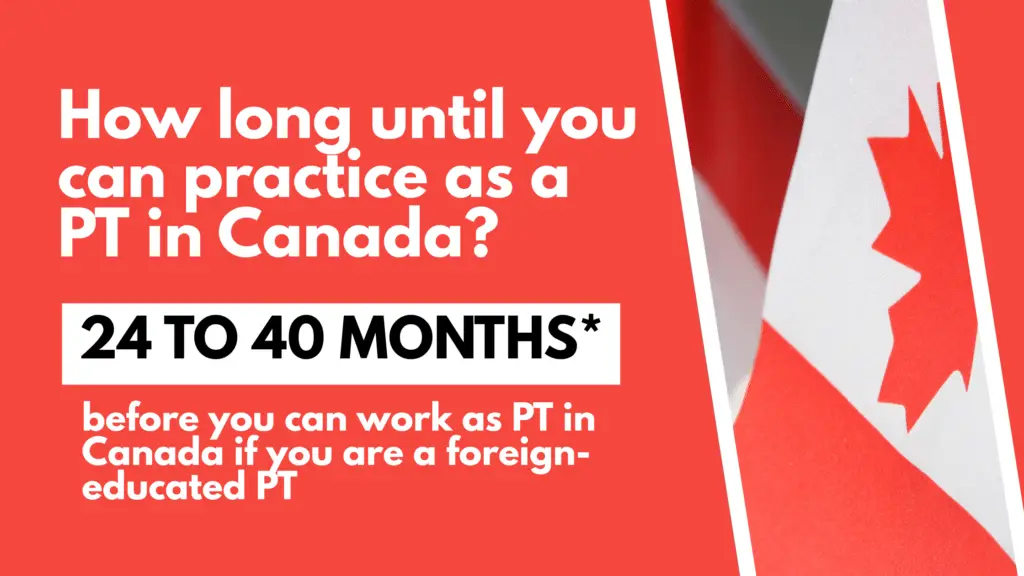
24 months to 40 months before you can work as PT in Canada*
Bottom line: From start to first Canadian job it’s common for the process to take 24–40 months or more, depending on your starting point, readiness, luck with timelines and ability to pass the PCE in first try.
Pros of migrating to Canada as a physical therapist
Strong demand & stable job market:
Ongoing need in hospitals, rehab centres, eldercare and community care.
Competitive wages with good benefits:
Many full-time roles include benefits and pension/retirement contributions.
Quality of life & public healthcare:
Universal healthcare system and strong workplace protections are attractive to many healthcare professionals.
Career growth & specialization opportunities:
Canadian workplaces often support continuing education and specialization.
Pathways to permanent residency:
Healthcare occupations are frequently prioritized in provincial nominee programs and federal skilled worker categories (depending on immigration policy cycles).
Cons / realistic challenges of migrating to Canada if you’re a Physical Therapist
Up-front time and money before you can practice:
Credentialing, exams, and prep are costly and take months.
Exam difficulty & lower pass rates for internationally trained applicants:
Internationally educated physiotherapists historically face lower pass rates on competency exams and often need extra prep or bridging. Expect rigorous study and possible multiple attempts.
Regional variability in jobs:
Some provinces are more competitive; others face shortages. You may have to be geographically flexible.
Licensing fragmentation:
CAPR credentialing and national exams help standardize things, but provincial regulators issue practice licenses and may add province-specific steps.
Cost of living & taxes: Higher wages in some provinces can be offset by higher housing costs (e.g., Vancouver), so net benefits depend on location choice.
Practical checklist
Checklist before you move
Gather original transcripts, clinical placement records, identity documents, and certified translations.
Check whether your education is from an exempt jurisdiction (language/test exemptions).
Register for and prepare approved language tests if needed.
Budget for credentialling fee (~CAD $1,486), exam fees (CAD $1,400–$2,500+), and bridging costs.
Frequently asked questions of internationally-educated PTs planning to migrate to Canada
The Canadian Alliance of Physiotherapy Regulators (Alliance / CAPR) pages for internationally trained candidates list requirements, timelines, fees, and application steps — start there.
Expect at least CAD $1,500–$3,500 for core fees (credential assessment + at least one exam attempt), with realistic total budgets of $35,145.22–$46,860.30+ including consulting agency fees, airfare, housing accommodation, healthcare course, visa processing and miscellaneous and incidentals.
Not always. Skilled immigrant streams and provincial nominee programs sometimes accept applicants without a prior job offer, but having an employer can speed some streams. Coordinating credentialing and immigration strategy is ideal. If you're a PT whose goal is to earn right away, it would be best to find an employer before going to Canada to consider the cost of living you will have to save before you can find a job.
An entry-level physical therapist (PT) in Canada earns approximately $45,000 to $65,000 CAD per year (around $44,856-$60,000+), depending on the province and experience level within the first three years. Wages can range from roughly $29-$45 per hour, with higher rates in provinces like British Columbia and Ontario. This is according to https://ca.jobted.com/salary/physical-therapist
Closing — is migrating to Canada worth it?
If your goals are stable healthcare work, competitive compensation, and a high quality of life in a country with universal healthcare and strong worker protections, Canada remains an attractive destination for many physiotherapists.
However, the route is not instant:
it requires strategic planning, financial investment, and time to clear credentialing and licensing hurdles.
If you prepare (documents, finances, study plan) and choose the right province or employer, most internationally trained PTs who commit to the process succeed.