Why International Physical Therapists Often Fail the APC Assessment — What You Should Know
For many internationally educated physiotherapists pursuing to work in Australia, passing the assessment of the Australian Physiotherapy Council (APC) is the critical step to working as a licensed physiotherapist in Australia.
But the reality is stark: many PTs fail — sometimes multiple times — or give up entirely.
In this article, we explore why international physical therapists fail the APC assessment, what the common obstacles are, and what alternatives exist if Australia doesn’t work out.
Table of Contents
What is the APC Assessment — and What Does “Fail” Mean?
The APC is the official body in Australia responsible for assessing overseas-qualified physiotherapists who want to practice there.
To become eligible for registration, international PTs must complete a series of assessments (eligibility assessment, written assessment, clinical assessments / simulation exams) to demonstrate that their education, clinical knowledge, and skills meet the standard required for physiotherapy practice in Australia.
Failing the APC assessment means either failing the written or, more commonly, the clinical assessment (or both) — and being unable to progress to full registration unless you successfully re-attempt (or meet remedial requirements).
Is the APC Written and Clinical Exam Difficult?
Pass Rate / Failure Rate — What the Data Says
According to the APC itself (in a recent insight article), a study found high failure rates across multiple clinical assessment areas, especially in “ability to interpret and analyse assessment findings” and “developing a physiotherapy plan.”
Specifically:
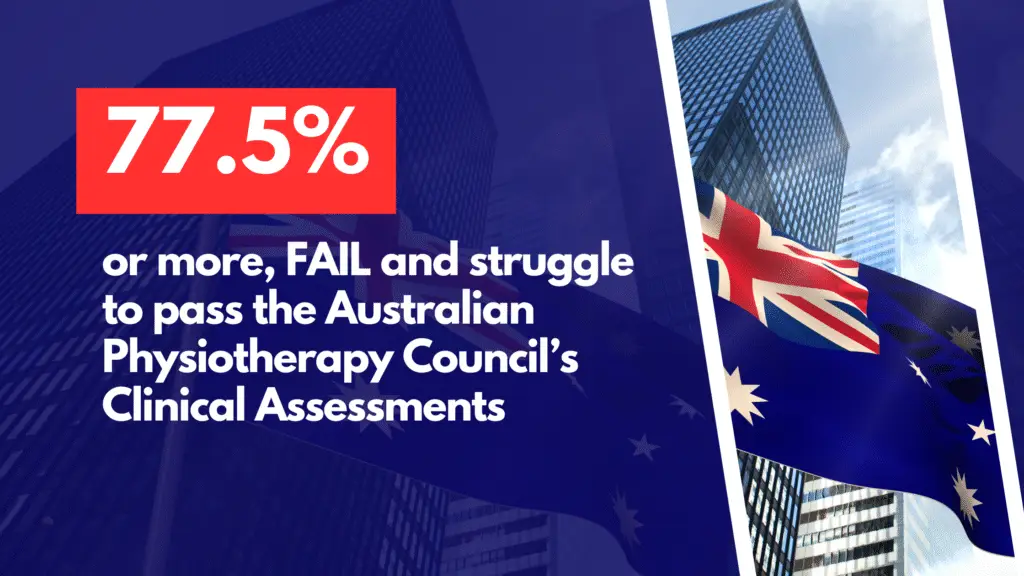
Many candidates — irrespective of their area (musculoskeletal, neuro, cardiorespiratory) — scored poorly (with 77.5% or greater failure rates in some assessment domains) when evaluated against the “Moderated Assessment Form.”
The root issue mostly lies in clinical reasoning — the capacity to gather patient data, analyze them, make context-sensitive decisions, and craft an individualized treatment plan rather than applying “recipe-based” standard plans.
In short: many overseas candidates — especially those trained in different systems — struggle significantly with the type of reasoning, decision-making, and clinical adaptation expected by APC assessors.
Because of this, passing on the first attempt is far from guaranteed. For many, repeated attempts are necessary; for some, the gap between expectations and actual performance proves too wide.

The Challenge of Migrating to Australia — Beyond Just Exams
Why is the APC assessment so tough for internationally educated PTs? Here are key challenges:
1. Clinical reasoning & context difference
As noted, many international PTs come from education systems where physiotherapy practices, scope of practice, and clinical approaches differ from Australian standards. This difference becomes starkly visible during APC’s clinical simulations, which expect evidence-based care, patient-centred plans, and flexible adaptation depending on patient background, comorbidities, social context, and local healthcare norms.
Because of these differences, some candidates fall into “cookie-cutter” approaches — generic treatment plans that don’t fit specific simulated patients — which the APC assessors frequently mark down.
2. Strict assessment standards (equivalent to Australian entry-level graduates)
APC emphasizes that all physiotherapists — whether locally trained or internationally educated — must meet the same “entry-level physiotherapist” thresholds.
This means that what may be accepted as “experienced PT” in one’s home country may still be judged insufficient under Australian standards, especially in areas like documentation, clinical reasoning, cultural safety, patient communication, and evidence-based practice.
3. High mental and financial burden
Undergoing APC assessments involves costs for application, travel (if simulation lab is abroad), possibly repeated attempts if you fail, and the pressure of simulation-based practical assessment. For many international PTs, that means time, money, and emotional investment — which can become overwhelming especially when success isn’t guaranteed.
Lack of Review Centers or Specialized Prep Facilities for APC Exams: A Major Barrier
One of the lesser-discussed — but very real — challenges for internationally educated PTs (e.g. from the Philippines) is the lack of local review centers or preparatory courses specifically designed for APC exams.
Because APC’s clinical assessment simulations and evaluation criteria are quite specific to the Australian healthcare context (clinical reasoning, treatment planning, cultural safety, patient-centred care), many international PTs find it difficult to self-study or rely solely on their prior education.
There are very few (if any) formal training or review centers abroad that simulate the APC assessment format, provide mock simulations, or train candidates in Australian-style physiotherapy practice — especially outside Australia (or outside major cities in Australia).
As a result, many candidates enter the exam with minimal preparation tailored to the APC format, which increases the risk of failing.
Some overseas-trained physiotherapists have reportedly abandoned their plans or changed careers because of repeated failures, delays, or lack of support structures.

Alternative Countries & Options for International PTs — If APC is Too Tough
If you’re an internationally trained PT considering opportunities abroad but concerned about APC’s rigour and low success rates, here are alternative pathways and best countries to migrate to as a Physiotherapist that you may consider:
1. United Kingdom (UK)
The UK is often cited as a more accessible option for foreign PTs. Registration with their regulatory body (Health and Care Professions Council — HCPC) is comparatively more straightforward, with fewer simulation-based barriers (though standards remain high). Many internationally educated PTs succeed here without repeated clinical simulation exams.
2. Canada
Some PTs look into Canadian registration/licensure systems for physiotherapy. While there are credential evaluations and examinations, the process might be more transparent and sometimes more flexible compared to APC’s clinical-simulation-heavy model.
3. United States
Many Filipino PTs still choose USA as their #1 destination because of the highest pay and higher success rate for licensure and migration. Many agencies also offer assistance and sponsorship to help Physical therapists get a job in the United States.
Final Thoughts — Should You Attempt APC Assessment?
The short answer: Yes — but with careful preparation and realistic expectations.
If you’re an internationally educated PT hoping to migrate to Australia, know this:
The APC assessment is designed to ensure safe, high-quality physiotherapy services for all patients in Australia.
The bar is high, especially in clinical reasoning and treatment planning — areas where many candidates fail.
Passing often requires more than just textbook knowledge — it demands adaptation to a different healthcare system, cultural context, strong communication, and analytical thinking.
Without adequate preparation (especially given the lack of specialized review centers), even very capable PTs may fail.
But if you persist, study effectively, and perhaps seek local mentorship or Australian-style clinical exposure, getting certified and practicing as a PT in Australia is achievable.
If APC doesn’t work out, don’t lose hope — there are other countries and pathways where your physiotherapy skills can still translate into fulfilling international careers.